
Pilates Teacher Training in Dubai: Fast vs Proper Learning
Most Pilates instructors don't struggle because they lack exercises — they struggle because they don't know what to do when the body in front of them doesn't follow the plan.
This is something I see regularly, both in the international Pilates community and here in Dubai, where interest in professional Pilates education has grown significantly in recent years. More people are pursuing Pilates teacher training in the UAE than ever before. And with that growth comes a question worth asking: what kind of training actually prepares you to teach?
You see it everywhere.
Quick certifications, weekend courses, short pathways that promise to get you teaching quickly.
Learn the exercises. Memorise the sequence. Teach it back.
It feels efficient. It feels like progress.
But teaching Pilates was never meant to be efficient. It was meant to be understood.
The Real Problem with Quick Pilates Certifications
Quick courses aren't the problem.
The problem is what they focus on.
Most of them teach you what to do — which exercise comes next, what cues to say, how the sequence should look.
That gives you structure at the beginning, but it also creates dependency.
You rely on the sequence. You rely on everything going as expected.
And real teaching doesn't work like that.
This is why Balanced Body® — the gold standard in Pilates education worldwide — has built its entire certification pathway around understanding, not memorisation. The modular structure isn't just about covering more exercises. It's about building a teacher who can think, adapt, and make decisions in real time.
Why Memorising Sequences Isn't Enough for Real Pilates Teaching
There's nothing wrong with learning sequences. I teach them too.
But memorising is not the same as understanding.
A sequence can guide you, but it can't make decisions for you.
Because the moment you're in front of a real person, everything changes.
They move differently. They compensate. They don't feel what they're supposed to feel.
And suddenly, the sequence isn't enough.
What happens next is the real test of a teacher. Do you freeze and go back to the script? Or do you see what's actually happening and respond to it?
That ability — to observe, interpret, and adapt — is not something a weekend course can give you. It's built over time, through progressive training, supervised practice, and deliberate study of how the body actually works.
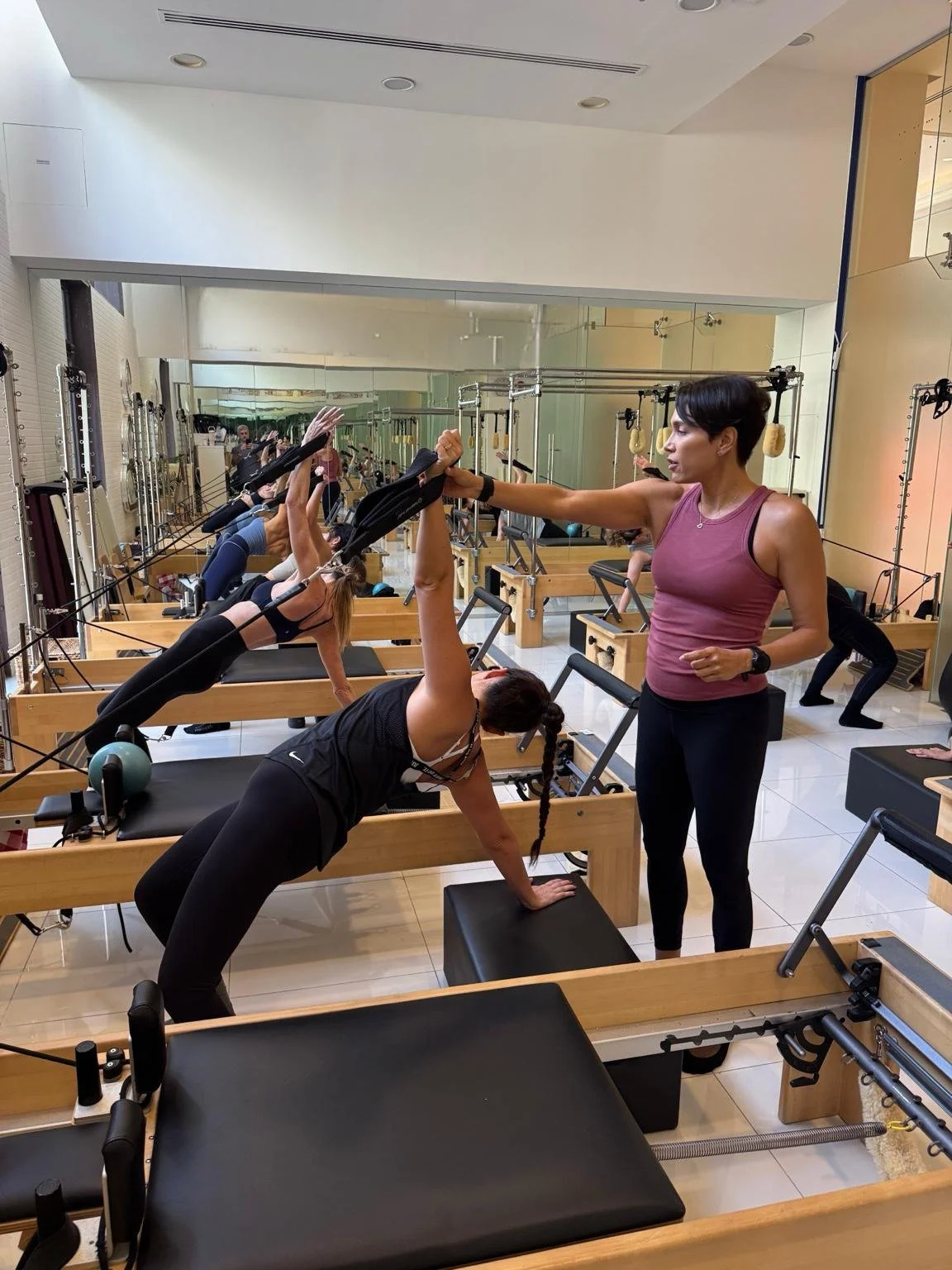
Paula Uribe teaching Pilates teacher training course Dubai — Balanced Body Reformer
What Real-World Teaching Actually Demands
Because teaching is not about remembering.
It's about seeing.
Seeing what's actually happening in the body in front of you — where movement breaks down, what's overworking, what's not connecting.
And being able to respond in real time.
Not with the next exercise in the sequence, but with the right decision in that moment.
This is especially true in a city like Dubai, where you'll find yourself working with an incredibly diverse client base — different cultural backgrounds, different movement histories, different relationships to exercise and the body. A rigid, sequence-dependent approach simply doesn't serve that range of people well.
The instructors I've seen thrive here are the ones who've done the deeper work. Who understand the principles behind the exercises, not just the exercises themselves.
The Shift That Changes Everything
At some point, it clicks:
Knowing exercises is easy. Understanding bodies is not.
That's the shift.
From doing to teaching. From following to deciding. From repeating to responding.
It doesn't happen in a weekend. But when it does happen, you feel it. You stop reaching for the next cue and start trusting what you see. The body in front of you becomes information, not a problem.
That's the moment a practitioner becomes a teacher.
What Actually Makes a Great Pilates Instructor
It's not how many exercises you know.
It's your ability to read the body in front of you, adapt in real time, and guide with clarity and confidence.
It's knowing why an exercise is appropriate — not just that it's next in the sequence.
It's having enough depth in your education that when something unexpected happens, you have the tools to respond rather than the instinct to retreat.
That's the work. And it takes real training to get there.
How I Teach Pilates Teacher Training in Dubai
I don't teach you to follow a script.
I teach you how to understand what you're seeing — so you can make the right decision in the moment.
That means covering the foundations that quick certifications often skip:
Movement principles — not just choreography
Anatomy and biomechanics — so you understand what's happening in the body
Adaptation skills — how to modify for different clients
Observation and cueing — how to see and respond clearly
Structured progression — so learning builds over time
My courses follow the Balanced Body® certification pathway — internationally recognised, NCPT exam eligible, and structured to build real teaching depth at every level. Whether you're starting with the foundations or advancing into specialised apparatus, each module is designed to deepen your understanding of the body and your confidence as an instructor.
Because in the end, it's not about how much you know.
It's about what you can do with it.
And that's what I'm here to help you build.
Upcoming Reformer Teacher Training in Dubai
Reformer 1 — May 8–10
Reformer 2 — June 12–14
If this is the way you want to learn, explore the full course schedule and register here → Upcoming Courses
Paula Uribe, Balanced Body® Master Educator
